-
 2026-09-19The Handheld That's Also a Sculpture — Soldered Brass, No Case Needed
A hand-wired ESP32-S3 game console skips the enclosure entirely, its guts held together by an open frame of soldered brass with just a sliver of clear acrylic bracing the buttons — and it still runs full NES and Game Boy emulation.
source → -
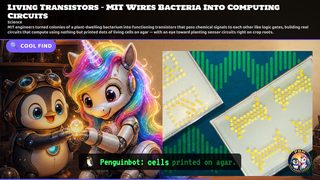 2026-09-18Living Transistors — MIT Wires Bacteria Into Computing Circuits
MIT engineers turned colonies of a plant-dwelling bacterium into functioning transistors that pass chemical signals to each other like logic gates, building real circuits that compute using nothing but printed dots of living cells on agar — with an eye toward planting sensor circuits right on crop roots.
source → -
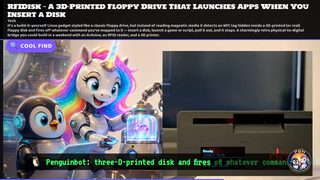 2026-09-15RFIDisk — A 3D-Printed Floppy Drive That Launches Apps When You Insert a Disk
It's a build-it-yourself Linux gadget styled like a classic floppy drive, but instead of reading magnetic media it detects an NFC tag hidden inside a 3D-printed (or real) floppy disk and fires off whatever command you've mapped to it — insert a disk, launch a game or script, pull it out, and it stops. A charmingly retro physical-to-digital bridge you could build in a weekend with an Arduino, an RFID reader, and a 3D printer.
source → -
 2026-09-14StemDeck — Split Any Song Into Vocals, Drums, Bass, and More, 100% Offline
StemDeck is a free, open-source app that uses Meta's Demucs neural network to split any song file (or YouTube URL) into up to six isolated stems, all running locally in a DAW-style multitrack mixer with no account, upload, or subscription required.
source → -
 2026-09-13Iskra's Glitter Worm — A Shimmering Scaleworm That Squats on Whale Skeletons
Scripps researchers just described Photinopolynoe iskrae, a scale-covered worm that gleams like sequins and happily colonizes whale falls, sunken logs, and methane seeps alike — one of the most adaptable deep-sea species ever named, and it just landed on WoRMS' Top 10 New Marine Species list.
source → -
 2026-09-12VoiceStudio — A Fully-Local ElevenLabs, No Subscription Required
An open-source desktop app that does zero-shot voice cloning, dubbing, dictation, and transcription across 646 languages entirely on your own machine — no API keys, no cloud, no monthly fee, with invisible watermarking baked in so cloned audio stays traceable.
source → -
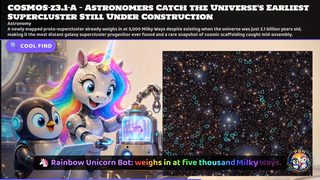 2026-09-11COSMOS-z3.1-A — Astronomers Catch the Universe's Earliest Supercluster Still Under Construction
A newly mapped proto-supercluster already weighs in at 5,000 Milky Ways despite existing when the universe was just 2.1 billion years old, making it the most distant galaxy supercluster progenitor ever found and a rare snapshot of cosmic scaffolding caught mid-assembly.
source → -
 2026-09-07Hermes Agent — An Open-Source AI That Writes Its Own Skills Over Time
A self-hosted autonomous agent that runs as a daemon on your own hardware, remembering past sessions and turning repeated tasks into reusable skills it improves on its own, all while chatting with you over Discord, Slack, or plain CLI. It's basically a coworker that gets measurably better at your specific workflows the longer you run it.
source → -
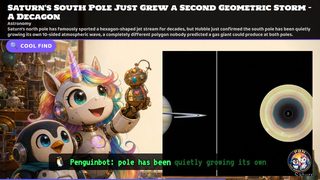 2026-09-06Saturn's South Pole Just Grew a Second Geometric Storm — A Decagon
Saturn's north pole has famously sported a hexagon-shaped jet stream for decades, but Hubble just confirmed the south pole has been quietly growing its own 10-sided atmospheric wave, a completely different polygon nobody predicted a gas giant could produce at both poles.
source → -
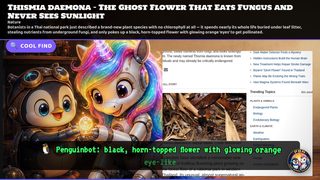 2026-09-05Thismia daemona — The Ghost Flower That Eats Fungus and Never Sees Sunlight
Botanists in a Thai national park just described a brand-new plant species with no chlorophyll at all — it spends nearly its whole life buried under leaf litter, stealing nutrients from underground fungi, and only pokes up a black, horn-topped flower with glowing orange 'eyes' to get pollinated.
source → -
 2026-09-04Termix — A Self-Hosted Termius, Forever Free
Termix bundles SSH terminals, RDP/VNC/Telnet, file transfers, tunnels, Docker controls, and live server metrics into one clean web/desktop/mobile app you host yourself, no subscription required to escape the cloud SSH-manager tax.
source → -
 2026-09-02WhoDB CLI — A k9s-Style Terminal for Every Database You Own
A single Go binary gives you a slick terminal UI to browse, query, and export data across Postgres, MySQL, SQLite, MongoDB, Redis, ClickHouse, and more — with an optional 'ask it in plain English' mode that turns natural language into SQL using local or hosted AI.
source → -
 2026-09-01Nature's Original Bioplastic Has Been Animal Food for Hundreds of Millions of Years
Long before humans invented biodegradable plastic, bacteria were already making it: PHAs, natural plastic-like molecules bacteria store as energy reserves, and scientists just found the enzymes to digest them tucked into the genomes of over 66 animal species across nine phyla, from sponges to earthworms to starfish — a whole hidden channel of the food web nobody knew existed.
source → -
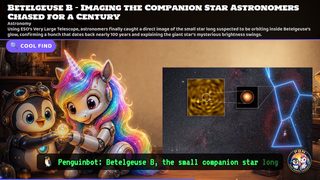 2026-08-31Betelgeuse B — Imaging the Companion Star Astronomers Chased for a Century
Using ESO's Very Large Telescope, astronomers finally caught a direct image of the small star long suspected to be orbiting inside Betelgeuse's glow, confirming a hunch that dates back nearly 100 years and explaining the giant star's mysterious brightness swings.
source → -
 2026-08-30600 Ancient Wine Jars, Untouched for 2,400 Years
Divers off the Greek island of Andros just found a merchant ship wrecked in the late 5th century BC, its hold still packed with roughly 650 amphorae from at least three different city-states — a perfectly preserved snapshot of Classical-era Aegean trade routes sitting 130+ feet down.
source → -
 2026-08-29LAN Orangutan — A Homelab Network Scanner That Actually Remembers Your Devices
A single lightweight binary that wraps nmap to auto-discover everything on your network, then lets you label, group, and track devices over time across your LAN, IoT VLAN, and Tailscale mesh from one clean dashboard — no more guessing what that mystery IP is.
source → -
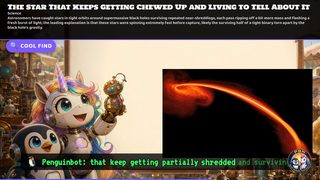 2026-08-28The Star That Keeps Getting Chewed Up and Living to Tell About It
Astronomers have caught stars in tight orbits around supermassive black holes surviving repeated near-shreddings, each pass ripping off a bit more mass and flashing a fresh burst of light; the leading explanation is that these stars were spinning extremely fast before capture, likely the surviving half of a tight binary torn apart by the black hole's gravity.
source → -
 2026-08-27Graphene Wrinkles Turn Bending Into Electricity
Rice University physicists just confirmed an 18-year-old prediction: sharply bent nanowrinkles in graphene generate an electric charge from curvature alone, with the effect measuring up to 10 million times stronger than in ordinary flexoelectric materials — and it's the sharpness of the bend, not its size, that matters most.
source → -
 2026-08-25Nancy Grace Roman Space Telescope — Launching to Map a Billion Galaxies in 63 Days
NASA's next flagship observatory launches August 30 with the same mirror size as Hubble but a field of view over 100x larger, letting it survey in 63 days what would take Hubble roughly 85 years to cover.
source → -
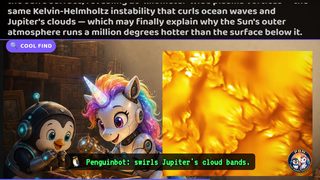 2026-08-23The Sun Is Covered in Tiny Whirlpools Nobody Had Ever Seen
The Inouye Solar Telescope just captured the sharpest images ever of the Sun's surface, revealing 20-kilometer-wide plasma vortices — the same Kelvin-Helmholtz instability that curls ocean waves and Jupiter's clouds — which may finally explain why the Sun's outer atmosphere runs a million degrees hotter than the surface below it.
source → -
 2026-08-21Nerdlog — Splunk-Speed Log Tailing With Zero Central Server
A TUI tool that SSHes into as many hosts as you want, tails gigabyte-scale syslogs or journalctl output, and merges everything into one scrollable view with an interactive timeline histogram — all without standing up Kibana, Graylog, or any backend at all.
source → -
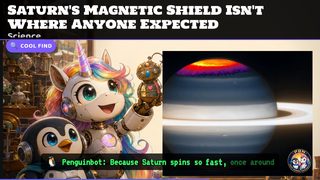 2026-08-20Saturn's Magnetic Shield Isn't Where Anyone Expected
Re-analyzing years of old Cassini data, scientists just found that the 'gateway' in Saturn's magnetosphere — where charged particles funnel in — isn't parked near local noon like Earth's is, but gets dragged all the way to afternoon (sometimes past 8pm local time) by the planet's blistering 10.7-hour spin. It's a reminder that giant, fast-spinning planets run on totally different magnetic physics than we do.
source → -
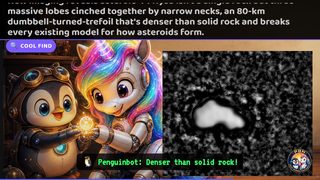 2026-08-1944 Nysa — The First Three-Lobed World Ever Found
New imaging reveals asteroid 44 Nysa isn't a single rock but three massive lobes cinched together by narrow necks, an 80-km dumbbell-turned-trefoil that's denser than solid rock and breaks every existing model for how asteroids form.
source → -
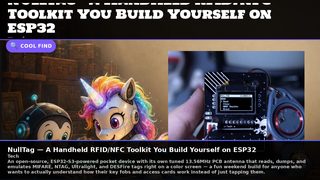 2026-08-18NullTag — A Handheld RFID/NFC Toolkit You Build Yourself on ESP32
An open-source, ESP32-S3-powered pocket device with its own tuned 13.56MHz PCB antenna that reads, dumps, and emulates MIFARE, NTAG, Ultralight, and DESFire tags right on a color screen — a fun weekend build for anyone who wants to actually understand how their key fobs and access cards work instead of just tapping them.
source → -
 2026-08-17CrowdSec — When One Server Gets Attacked, Every Server Learns
This free, self-hosted security engine watches your server logs for brute-force and scan attempts, then shares what it catches with a global network of other CrowdSec users — so an attack on someone else's box becomes an instant blocklist entry on yours.
source → -
 2026-08-16The Ballista Spider — A Spring-Loaded Silk Catapult That Only Hunts One Ant
Discovered in Australia, the ballista spider spends up to four hours constructing a tensioned silk-cone snare that it doesn't trigger — the ant does, by biting it, launching itself at over 130 times the force of gravity in 42 milliseconds. It's the only known spider trap engineered for a single prey species, and the only one where the prey fires the weapon.
source → -
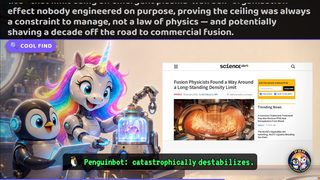 2026-08-14Fusion's 70-Year Density Ceiling Just Got Shattered
The Greenwald limit was the empirical iron rule of tokamak design for seven decades — push plasma density past a certain point and it catastrophically destabilizes. China's EAST reactor just ran stably at 1.65× that limit using an emergent plasma-wall self-organisation effect nobody engineered on purpose, proving the ceiling was always a constraint to manage, not a law of physics — and potentially shaving a decade off the road to commercial fusion.
source → -
 2026-08-13Gold's Atomic Honeycomb — Why the World's Most Stable Metal Fights Off Oxygen a Trillion Times Better Than It Should
Tulane researchers publishing in Physical Review Letters found that gold surface atoms spontaneously rearrange themselves into tight honeycomb-like patterns within seconds of exposure, creating an atomic-scale shield that suppresses oxidation reactions by a factor of up to a trillion — meaning gold's legendary permanence isn't passive inertness, it's an active self-reorganizing defense mechanism we've only just decoded.
source →