-
 2026-11-22Untitled (Young Woman with Gold Earrings)
Smithsonian American Art Museum holds this 1850s portrait of a young woman wearing gold earrings, made by an artist whose name has been lost to history.
source → -
 2026-11-20Feast Day: San Juan Pueblo
Step into a 1920s celebration at San Juan Pueblo, captured by William Penhallow Henderson, the Massachusetts-born artist who later made his home in Tesuque, New Mexico.
source → -
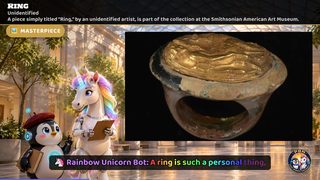 2026-11-19Ring
A piece simply titled "Ring," by an unidentified artist, is part of the collection at the Smithsonian American Art Museum.
source → -
 2026-11-15Dying Buffalo Bull in a Snowdrift
In the 1830s, George Catlin, born in Wilkes-Barre, Pennsylvania, captured a dying buffalo bull sinking into a winter snowdrift in this work from the Smithsonian American Art Museum.
source → -
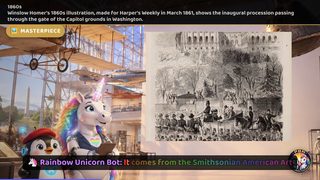 2026-11-13The Inaugural Procession at Washington Passing the Gate of the Capitol Grounds, from Harper's Weekly, March 16, 1861
Winslow Homer's 1860s illustration, made for Harper's Weekly in March 1861, shows the inaugural procession passing through the gate of the Capitol grounds in Washington.
source → -
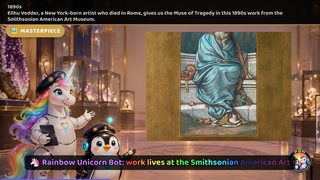 2026-11-12Muse of Tragedy
Elihu Vedder, a New York-born artist who died in Rome, gives us the Muse of Tragedy in this 1890s work from the Smithsonian American Art Museum.
source → -
 2026-11-06Kwan Yin (Goddess of Mercy)
Created in the 1640s by an unidentified Chinese artist, this representation of Kwan Yin, the Goddess of Mercy, now graces the Smithsonian American Art Museum.
source → -
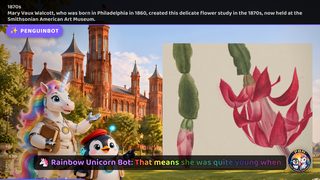 2026-11-01(Untitled--Flower Study)
Mary Vaux Walcott, who was born in Philadelphia in 1860, created this delicate flower study in the 1870s, now held at the Smithsonian American Art Museum.
source → -
 2026-10-30Smoking the Shield
In the 1830s, George Catlin portrayed a Dakota scene titled "Smoking the Shield," now held in the Smithsonian American Art Museum's collection.
source → -
 2026-10-27Head of a Cat
Paul Wayland Bartlett, a New Haven-born sculptor who later worked in Paris, captured the curious charm of a feline in this 1880s work, Head of a Cat.
source → -
 2026-10-26The Storm
Dutch artist Ludolf Backhuysen, born in Emden and later of Amsterdam, brings the drama of nature to life in this 1700s work, The Storm.
source → -
 2026-10-23Untitled (Interior View)
From the Smithsonian American Art Museum, Walter Gay, born in Hingham, Massachusetts, offers an untitled interior view from the 1930s, painted late in his life in France.
source → -
 2026-10-21Necklace
A piece simply titled "Necklace," made by an unidentified artist and held in the collection of the Smithsonian American Art Museum.
source → -
 2026-10-19Sidewall
From the 1800s, this untitled-artist "Sidewall" is a design piece preserved by the Cooper Hewitt, Smithsonian Design Museum.
source → -
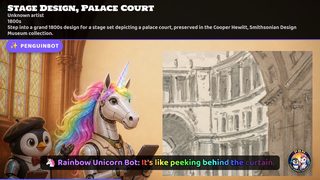 2026-10-16Stage Design, Palace Court
Step into a grand 1800s design for a stage set depicting a palace court, preserved in the Cooper Hewitt, Smithsonian Design Museum collection.
source → -
 2026-10-11Ornament Design, Foliate Panel between Roman Myrtle and Laurel Crowns
Michel Angelo Pergolesi's 1770s foliate ornament design nestles between Roman myrtle and laurel crowns, now preserved at Cooper Hewitt.
source → -
 2026-10-09View of a Village in Mountainous Country
Carlo Marchionni, the 18th-century Italian architect, captured a quiet mountain village in this 1770s work now held at Cooper Hewitt.
source → -
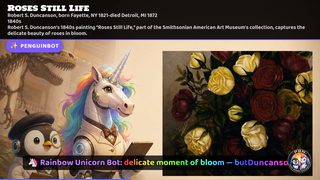 2026-10-08Roses Still Life
Robert S. Duncanson's 1840s painting "Roses Still Life," part of the Smithsonian American Art Museum's collection, captures the delicate beauty of roses in bloom.
source → -
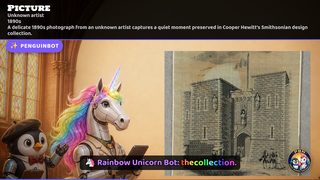 2026-10-05Picture
A delicate 1890s photograph from an unknown artist captures a quiet moment preserved in Cooper Hewitt's Smithsonian design collection.
source → -
 2026-10-02Eight Urns
Gilles-Marie Oppenord's 1690s design "Eight Urns" showcases French decorative artistry, now preserved at Cooper Hewitt, Smithsonian Design Museum.
source → -
 2026-09-25Candelabrum
Pierre-Philippe Thomire's ornate 1810s candelabrum showcases the French artist's masterful decorative craftsmanship, now held by Cooper Hewitt, Smithsonian Design Museum.
source → -
 2026-09-24Hooked Rug with Stars, Crescent and Fret
This 1850s hooked rug, made by an unidentified artist, features a striking design of stars, a crescent moon, and a fret pattern.
source → -
 2026-09-18Album of Architectural Prints
François de Cuvilliés the younger's 1770s album showcases the architectural print artistry now preserved at Cooper Hewitt, Smithsonian Design Museum.
source → -
 2026-09-11The Sky Simulated by Red Flamingoes, study for book Concealing Coloration in the Animal Kingdom
In this 1900s study, Abbott Handerson Thayer imagined the sky in fiery pink, part of his research on animal camouflage for a book on concealing coloration.
source → -
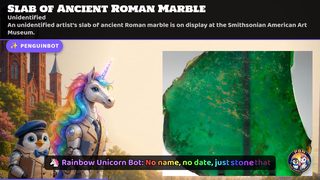 2026-09-04Slab of Ancient Roman Marble
An unidentified artist's slab of ancient Roman marble is on display at the Smithsonian American Art Museum.
source → -
 2026-09-02Louisiana Tanager, Clark's Crow, Lewis' Woodpecker
Scottish-born artist Alexander Lawson captured the Louisiana Tanager, Clark's Crow, and Lewis' Woodpecker, now held by the Smithsonian American Art Museum.
source → -
 2026-08-29Vase
This unattributed 1720s vase, part of the Cooper Hewitt, Smithsonian Design Museum collection, offers a rare glimpse into early 18th-century craftsmanship.
source → -
 2026-08-28Wild Animal Hunt (frieze)
This 1570s frieze by French artist Etienne Delaune depicts a dramatic wild animal hunt, now held at Cooper Hewitt, Smithsonian Design Museum.
source → -
 2026-08-25Title Page
Gilles-Marie Oppenord's 1740s Title Page brings 18th-century French design flair straight from the Cooper Hewitt, Smithsonian Design Museum.
source → -
 2026-08-21Window shade
This 1870s window shade, whose maker remains unknown, is preserved today by the Cooper Hewitt, Smithsonian Design Museum.
source → -
 2026-08-14Fragment
This intriguing piece, simply titled "Fragment" and held by the Cooper Hewitt, Smithsonian Design Museum, invites us to wonder about the story behind its mysterious unknown creator.
source →