-
 2026-09-19Brush lint out of the bobbin case and feed dogs regularly, and oil the machine per its manual.
Packed lint throws off bobbin tension and muffles the machine; routine cleaning prevents skipped stitches and jams.
-
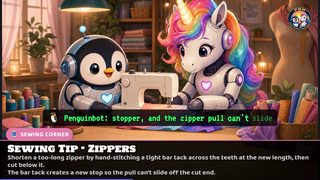 2026-09-18Shorten a too-long zipper by hand-stitching a tight bar tack across the teeth at the new length, then cut below it.
The bar tack creates a new stop so the pull can't slide off the cut end.
-
 2026-09-17Join elastic ends by overlapping them about an inch and stitching a box or zigzag through both layers.
An overlapped, multi-pass join is far stronger than a butted seam and won't pop under the stretch of wear.
-
 2026-09-16Before letting a garment out, check how much seam allowance there is to release, and press out the old stitch line once unpicked.
You can only let out as much as the allowance allows, and pressing removes the visible needle holes from the old seam.
-
 2026-09-15Use a press cloth between the iron and delicate, dark, or synthetic fabrics, and to protect any fusible work.
A press cloth prevents shine, scorch marks, and stray adhesive from ruining the fabric or gumming up your iron.
-
 2026-09-14Press fabric flat to remove all folds and creases right before you lay out and cut your pattern.
A crease or wrinkle distorts the cut shape, so a piece cut over a fold line will be the wrong size.
-
 2026-09-13Fuse or sew interfacing to collars, cuffs, and plackets before assembling them.
Interfacing gives structure so soft fabric holds its shape and doesn't collapse with wear.
-
 2026-09-12Before turning a stitched corner right side out, trim the point diagonally and trim a little off each side near it, then push it out with a blunt point turner.
Removing the bulk lets the seam allowances tuck inside so the corner turns to a sharp point without a lump.
-
 2026-09-11For a quick no-sew hem on non-stretch fabric, fold the hem over fusible hem tape and press with steam to bond it.
Fusible tape melts an adhesive between the layers, giving a clean hem without visible stitching on delicate or formal fabric.
-
 2026-09-10For a hand blind hem, catch just one or two threads of the garment face with each stitch, taking small bites every half inch.
Catching minimal fabric keeps the hem from showing as dimples or stitches on the right side.
-
 2026-09-09Attach double-fold bias binding by sewing the back first, wrapping to the front, then stitching in the ditch to catch the back fold.
Stitching in the ditch hides the finishing seam and reliably catches the wider back fold underneath.
-
 2026-09-08Sew two rows of long machine stitches around the sleeve cap between the notches, then gently pull the threads to ease the cap to fit the armhole.
A correctly eased sleeve cap curves smoothly without tucks or drag lines across the shoulder.
-
 2026-09-07Baste tricky areas with long hand or machine stitches in a contrast thread before final sewing, then pull them out afterward.
Basting holds layers exactly in place without pins, and contrast thread makes removal fast and obvious.
-
 2026-09-06For a centered zipper, baste the seam closed, press it open, then stitch the zipper from the right side an even distance each side of the seam.
Basting holds the seam shut so both stitch lines stay parallel and the teeth land exactly on the seamline.
-
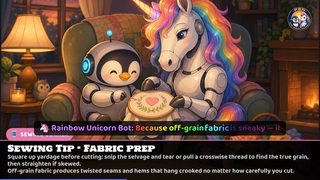 2026-09-05Square up yardage before cutting: snip the selvage and tear or pull a crosswise thread to find the true grain, then straighten if skewed.
Off-grain fabric produces twisted seams and hems that hang crooked no matter how carefully you cut.
-
 2026-09-04Cut straight edges and long pieces with a rotary cutter against a ruler on a self-healing mat instead of scissors.
The rolling blade follows a ruler precisely and doesn't lift or shift the fabric the way scissor blades do.
-
 2026-09-03Hem knits with a twin needle, lengthening the stitch and lowering top tension a touch; woolly nylon in the bobbin helps prevent tunneling.
The zigzag the two needles form underneath lets the hem stretch, and balanced tension stops the ridge from bunching between the rows.
-
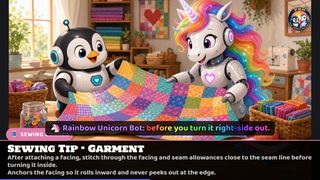 2026-09-02After attaching a facing, stitch through the facing and seam allowances close to the seam line before turning it inside.
Anchors the facing so it rolls inward and never peeks out at the edge.
-
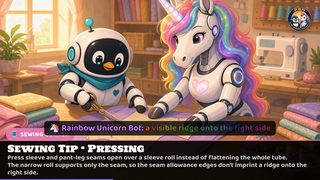 2026-09-01Press sleeve and pant-leg seams open over a sleeve roll instead of flattening the whole tube.
The narrow roll supports only the seam, so the seam allowance edges don't imprint a ridge onto the right side.
-
 2026-08-31Sew a French seam by stitching wrong sides together with a narrow allowance, trimming, then folding right sides together and stitching again to enclose the edge.
The second pass wraps the raw edge inside the seam, giving sheers and unlined garments a clean, fray-proof finish.
-
 2026-08-30Sew the last few stitches of a dart right off the fold's edge and shorten the stitch near the tip, then knot the tails by hand.
Running off the fold and avoiding backstitch at the point keeps the dart tip from forming a hard bubble or dimple.
-
 2026-08-29Secure serger chain tails by threading them back through the stitching with a tapestry needle or dabbing them with seam sealant.
Serged chains unravel from the ends, so burying or sealing the tail keeps the whole seam from coming undone.
-
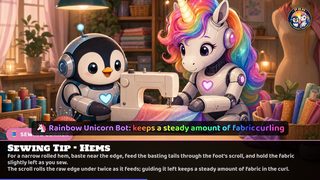 2026-08-28For a narrow rolled hem, baste near the edge, feed the basting tails through the foot's scroll, and hold the fabric slightly left as you sew.
The scroll rolls the raw edge under twice as it feeds; guiding it left keeps a steady amount of fabric in the curl.
-
 2026-08-27Use the needle-down setting (or hand-wheel the needle down) before lifting the foot to pivot at a corner.
The needle anchors the fabric so the corner stays perfectly aligned while you turn, avoiding a jog in the stitch line.
-
 2026-08-26Open a buttonhole by placing a pin across each end, then cutting between them with a seam ripper or small chisel.
The pins act as stops so the blade can't slice through the bar tacks at either end of the buttonhole.
-
 2026-08-25Choose a thread weight and fiber that matches your fabric — lightweight thread for sheers, heavier thread for denim or canvas.
Mismatched thread breaks under stress or pulls the fabric, especially on knits and heavy wovens.
-
 2026-08-24Switch to a ballpoint or jersey needle whenever you sew knit or stretch fabric.
Ballpoint tips push between fibres instead of piercing them, preventing snags and skipped stitches on stretchy fabric.
-
 2026-08-23Use a walking foot (or engage your dual feed) when sewing knits or multiple thick layers.
It feeds top and bottom layers evenly so they don't shift or pucker.
-
 2026-08-22Sew a quick muslin (toile) of an unfamiliar pattern in cheap fabric and fit it before cutting your good cloth.
A muslin reveals fit and length problems on scrap fabric, so you adjust the pattern before risking the real material.
-
 2026-08-21Start big projects with a fresh needle, and switch needle type to match the fabric.
A dull or wrong needle skips stitches, snags, and shreds thread.
-
 2026-08-20Transfer all pattern markings — darts, notches, pocket placement — with tailor's chalk or a tracing wheel before unfolding the pattern.
Accurate marks are the only way to match seams and position details correctly when sewing.
-
 2026-08-19Finish every raw seam allowance with a zigzag stitch, overlock, or pinking shears before or right after sewing.
Stops fraying that works its way into the seam over time and weakens the garment.
-
 2026-08-18Prewash and dry washable fabric the way you'll launder the finished item before you cut a single piece.
Most shrinkage happens in the first wash; doing it pre-cut means the finished garment won't shrink or distort.
-
 2026-08-17Press each seam before you cross it with another. Don't wait until the end.
Crossed seams set crooked if they aren't pressed flat first.
-
 2026-08-16Line pattern pieces up with the fabric grainline arrows before you cut.
Off-grain pieces twist and hang wrong no matter how well they're sewn.
-
 2026-08-15Backstitch a few stitches at the start and end of every seam so it can't unravel.
Locks the thread without a bulky knot.
-
 2026-08-14Clip into the seam allowance on inward curves and notch outward curves before turning.
Lets curved seams lie flat instead of bunching when turned right side out.
-
 2026-08-13Wind bobbins at a steady speed with the thread guided through the tension disc so it lays on evenly, not loose or lumpy.
An unevenly wound bobbin feeds inconsistently and is a frequent hidden cause of tension and looping problems.