-
 2026-09-19The Magdalen with the Smoking Flame
A small near light source makes near planes blaze and far planes plunge dark fast; honoring that steep falloff sells the nocturne.
source → -
 2026-09-18The Monk by the Sea
Friedrich gives the lone monk almost nothing but sky and sea, and that radical emptiness is precisely what conveys the sublime.
source → -
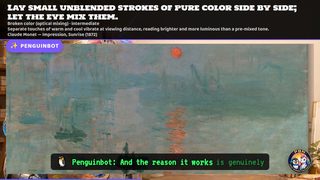 2026-09-17Impression, Sunrise
Separate touches of warm and cool vibrate at viewing distance, reading brighter and more luminous than a pre-mixed tone.
source → -
 2026-09-16Summer's Day (Jour d'été)
Bright outdoor light compresses values high; quick warm-and-cool dashes keep a pale painting from going chalky and flat.
source → -
 2026-09-15Arrangement in Grey and Black No. 1 (Whistler's Mother)
Whistler keeps almost everything in close greys and blacks, so the few light notes (face, cuffs, picture) carry the whole design.
source → -
 2026-09-14Impression, Sunrise
A tiny orange note against blue-gray water is nearly the same value, so it glows by hue contrast, not brightness.
source → -
 2026-09-13San Giorgio Maggiore at Dusk
Orange and blue are opposites; placed adjacent at sunset each intensifies the other, capturing the burn of last light.
source → -
 2026-09-12Self-Portrait with Beret and Turned-Up Collar
The transitional halftone is where a surface turns away from the light; control it and the form looks round without harsh contrast.
source → -
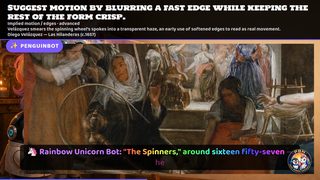 2026-09-11Las Hilanderas (The Spinners)
Velázquez smears the spinning wheel's spokes into a transparent haze, an early use of softened edges to read as real movement.
source → -
 2026-09-10Three Women in Church
Invisible, fully-blended handling is a deliberate choice — quiet finish can serve a subject as well as bravura.
source → -
 2026-09-09An Experiment on a Bird in the Air Pump
Distributing figures across the whole light-to-dark range by their distance from the source builds depth and directs the narrative.
source → -
 2026-09-08Portrait of the Marchesa Luisa Casati with a Greyhound
Elongated directional strokes imply swirl and momentum, animating an otherwise static pose.
source → -
 2026-09-07Las Meninas
A neutral grey-brown imprimatura instantly reads as the average light, so every lit accent and shadow gains relative punch with less paint.
source → -
 2026-09-06Wivenhoe Park, Essex
Sun adds yellow and shade adds blue to the same field, so splitting greens by temperature gives a meadow real light.
source → -
 2026-09-05The Fighting Temeraire
Atmosphere reddens light near the horizon and stays cool at the zenith; that warm-to-cool ramp is what makes a sky believable.
source → -
 2026-09-04Portrait of Madame Récamier
David abandoned this portrait, yet the loosely blocked background and lamp prove that suggested form often beats over-rendering.
source → -
 2026-09-03The Surrender of Breda
The upright lances form a rhythmic vertical screen that frames and points down to the key handover, organizing a crowded battle scene.
source → -
 2026-09-02The Bellelli Family
Degas separates the mother-and-daughters block from the turned father, and the gap between them tells the family's tension visually.
source → -
 2026-09-01The Ray
Chardin softens the cloth and shadows but crisps the cat and the ray's hanging gut, so edge hierarchy guides the eye through a still life.
source → -
 2026-08-31Wanderer above the Sea of Fog
Friedrich's Rückenfigur stands between us and the vista, giving scale and a surrogate eye so we look with him into the depth.
source → -
 2026-08-30Rain, Steam and Speed – The Great Western Railway
Glare and rain veil form; softening everything but the dark train conveys speed and luminosity better than crisp drawing.
source → -
 2026-08-29The Hay Wain
Constable greys and blues the far meadow while keeping the near bank rich and dark, so the eye reads recession by temperature and value.
source → -
 2026-08-28Nocturne in Black and Gold: The Falling Rocket
Whistler floats the night sky as thin washes and flicks the firework sparks in dense impasto, the lean-to-fat logic done in a single mood.
source → -
 2026-08-27Madame Moitessier
Ingres prized contour perfection; a mirror or phone-flip resets your eye so a drifting symmetry or tilt jumps out instantly.
source → -
 2026-08-26Water Lilies
A still pond is a mirror; its hue is borrowed from sky and foliage above, so reflections key the whole surface.
source → -
 2026-08-25Las Hilanderas (The Spinners)
Lost edges and a blurred rim convey speed; a crisp wheel would freeze it and read as a diagram.
source → -
 2026-08-24Almond Blossom
A colored contour plus stray dabs of the same color tie subject and ground together with vibration.
source → -
 2026-08-23Self-Portrait
Directional thick strokes that follow the planes of a face read as modeling, not just texture.
source → -
 2026-08-22Girl with a Pearl Earring
The diffuse reflection gives roundness; the single hard specular dot tells the eye the surface is wet, glassy, or metallic.
source → -
 2026-08-21Lady Agnew of Lochnaw
Economy keeps paint luminous; every extra pass over a correct stroke dulls and deadens it.
source → -
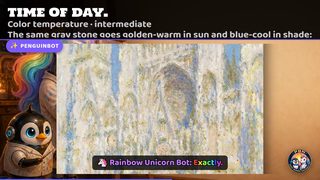 2026-08-20Rouen Cathedral, West Façade, Sunlight
The same gray stone goes golden-warm in sun and blue-cool in shade; temperature, not value, carries the light.
source → -
 2026-08-19Sunflowers
When stroke direction maps to the form, brushwork itself carries the drawing without extra outlining.
source → -
 2026-08-18Portrait of Juan de Pareja
Velázquez models flesh and the grey cloak with mostly earths, black and lead white, proving value and edge matter more than chroma.
source → -
 2026-08-17Malle Babbe
Direct single-session painting keeps strokes fresh and alive; reworking a dried alla prima passage kills it.
source → -
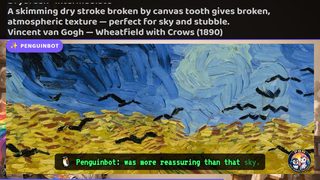 2026-08-16Wheatfield with Crows
A skimming dry stroke broken by canvas tooth gives broken, atmospheric texture — perfect for sky and stubble.
source → -
 2026-08-15Strolling along the Seashore
Broken cool accents in shadow keep darks luminous and full of reflected light, never muddy.
source → -
 2026-08-14Among the Sierra Nevada, California
A warm bright opening behind cool dark foreground reads as deep luminous space and a literal glow of atmosphere.
source → -
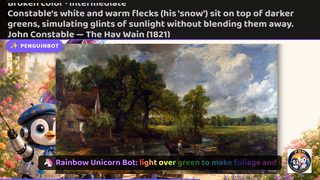 2026-08-13The Hay Wain
Constable's white and warm flecks (his 'snow') sit on top of darker greens, simulating glints of sunlight without blending them away.
source →