-
 2026-09-19The Great Wave off Kanagawa
The Great Wave off Kanagawa shows three small boats caught beneath a towering, curling wave, with Mount Fuji sitting calmly in the distance.
-
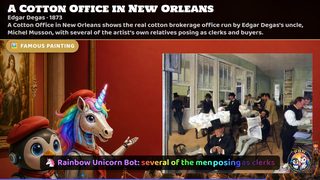 2026-09-18A Cotton Office in New Orleans
A Cotton Office in New Orleans shows the real cotton brokerage office run by Edgar Degas's uncle, Michel Musson, with several of the artist's own relatives posing as clerks and buyers.
-
 2026-09-17Seated Nude (Pink Nude)
Seated Nude, also called Pink Nude, is a small 1909 oil painting by Henri Matisse showing a woman resting in a simple seated pose.
-
 2026-09-16The Foxes
Franz Marc painted The Foxes in 1913, breaking the animals' bodies into angular, crystal-like shapes influenced by the Cubist paintings he'd been studying in Paris.
-
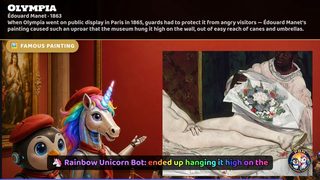 2026-09-15Olympia
When Olympia went on public display in Paris in 1865, guards had to protect it from angry visitors — Édouard Manet's painting caused such an uproar that the museum hung it high on the wall, out of easy reach of canes and umbrellas.
-
 2026-09-14The Gleaners
The Gleaners shows three peasant women bent over a field, gathering the last leftover grain after the main harvest, among the lowest-paid jobs in French farm life at the time.
-
 2026-09-13The Pont du Gard
"The Pont du Gard" is one of four huge paintings Hubert Robert made of Roman ruins in the south of France, each measuring nearly 8 feet square, together known as the Principal Monuments of France.
-
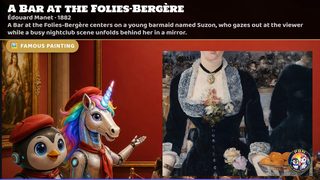 2026-09-12A Bar at the Folies-Bergère
A Bar at the Folies-Bergère centers on a young barmaid named Suzon, who gazes out at the viewer while a busy nightclub scene unfolds behind her in a mirror.
-
 2026-09-11Saturn Devouring His Son
Saturn Devouring His Son retells an old myth in which the god Saturn, afraid a child would one day overthrow him, tries to stop the prophecy from coming true.
-
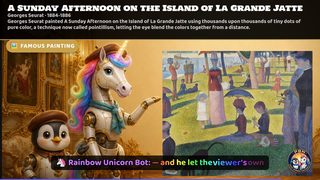 2026-09-10A Sunday Afternoon on the Island of La Grande Jatte
Georges Seurat painted A Sunday Afternoon on the Island of La Grande Jatte using thousands upon thousands of tiny dots of pure color, a technique now called pointillism, letting the eye blend the colors together from a distance.
-
 2026-09-09Lady with an Ermine
Lady with an Ermine shows Cecilia Gallerani, a young mistress of the Duke of Milan, cradling an animal that was also a sly pun on her own name — the Greek word for ermine, galee, echoes 'Gallerani.'
-
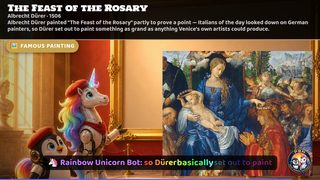 2026-09-08The Feast of the Rosary
Albrecht Dürer painted "The Feast of the Rosary" partly to prove a point — Italians of the day looked down on German painters, so Dürer set out to paint something as grand as anything Venice's own artists could produce.
-
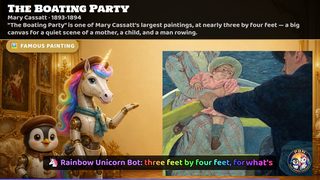 2026-09-07The Boating Party
"The Boating Party" is one of Mary Cassatt's largest paintings, at nearly three by four feet — a big canvas for a quiet scene of a mother, a child, and a man rowing.
-
 2026-09-06The Tower of Babel
Pieter Bruegel the Elder's Tower of Babel is packed with tiny detail — thousands of tiny figures swarm the scaffolding and streets around its base if you look closely enough.
-
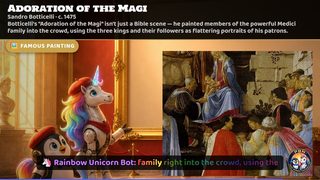 2026-09-05Adoration of the Magi
Botticelli's "Adoration of the Magi" isn't just a Bible scene — he painted members of the powerful Medici family into the crowd, using the three kings and their followers as flattering portraits of his patrons.
-
 2026-09-04The Kiss
Francesco Hayez's "The Kiss" looks like a simple romantic scene, but it's widely read as a coded political statement about Italian unification, with the couple's medieval clothing standing in for real alliances of the day.
-
 2026-09-03Mr and Mrs Andrews
Mr and Mrs Andrews shows the young couple posed beside their own farmland near Sudbury, with Thomas Gainsborough spending as much care on the wheat fields and trees as on the sitters themselves.
-
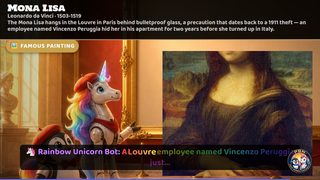 2026-09-02Mona Lisa
The Mona Lisa hangs in the Louvre in Paris behind bulletproof glass, a precaution that dates back to a 1911 theft — an employee named Vincenzo Peruggia hid her in his apartment for two years before she turned up in Italy.
-
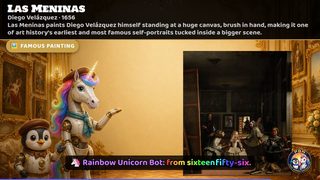 2026-09-01Las Meninas
Las Meninas paints Diego Velázquez himself standing at a huge canvas, brush in hand, making it one of art history's earliest and most famous self-portraits tucked inside a bigger scene.
-
 2026-08-31Flaming June
Flaming June shows a woman asleep in a sheer orange dress, painted by Frederic Leighton in 1895 in a nearly perfect square format.
-
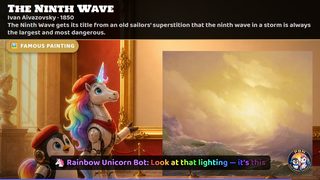 2026-08-30The Ninth Wave
The Ninth Wave gets its title from an old sailors' superstition that the ninth wave in a storm is always the largest and most dangerous.
-
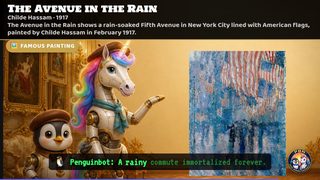 2026-08-29The Avenue in the Rain
The Avenue in the Rain shows a rain-soaked Fifth Avenue in New York City lined with American flags, painted by Childe Hassam in February 1917.
-
 2026-08-28Saint George and the Dragon
In Paolo Uccello's Saint George and the Dragon, the princess isn't fleeing in terror — she's calmly holding the dragon on a leash made from her own belt, as if she'd already tamed it before George arrived.
-
 2026-08-27La Grande Odalisque
La Grande Odalisque caused a stir when it was first shown, because critics noticed Jean-Auguste-Dominique Ingres had stretched the model's spine, adding what looks like a few extra vertebrae to make her curving pose more graceful.
-
 2026-08-26Breezing Up (A Fair Wind)
Breezing Up shows a catboat named the Gloucester cutting through choppy water with a man and three boys aboard, fresh from a day of fishing.
-
 2026-08-25The Cardsharps
"The Cardsharps" shows a well-off young man being hustled at cards by two con artists, one peeking at his hand, the other signaling with his fingers behind his back.
-
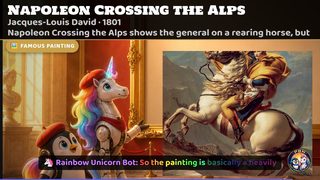 2026-08-24Napoleon Crossing the Alps
Napoleon Crossing the Alps shows the general on a rearing horse, but Napoleon actually crossed the real Alps on a mule, led carefully by a local guide, since the weather made anything more dramatic far too risky.